Genesis AI has “cracked dexterous manipulation,” CEO and co-founder Zhou Xian says.
To make his case, Xian hosted TechCrunch at Genesis AI’s Silicon Valley facility, where its physical AI model operated a pair of off-the-shelf robotic arms. In one demo, the arms picked up two small cardboard boxes, scanned them, placed them in a larger cardboard box, folded it closed, taped it shut, and then plucked a label off a strip of printer tape and applied it to the box.
It’s an impressive demo, exactly the kind of complex workflow that today’s robots struggle to complete. And while Genesis wouldn’t let your reporter mess with the robot’s mise en place to test its wiles, the company did agree to re-run the presentation. During the second go-round, the robot fumbled a box and had a heck of a time peeling the tiny adhesive label off the printer tape. A mistake, but also the kind of edge case that can be used to improve a model—”hiccup data,” a Genesis executive suggests.
This is the exact gap—between a lab demo and reliable automation—that Genesis, and the rest of the humanoid physical AI ecosystem, need to bridge if they want to avoid another robot winter. To do so, Xian’s company is announcing a $500 million Series A round led by Khosla Ventures, Premji Invest, and Eclipse.
Xian and Genesis president Théophile Gervet, who met as graduate students in a Carnegie Mellon University lab, cofounded the company in 2024. Genesis announced its $105 million seed round in July 2025. The company’s strategy is vertical integration: generating the bulk of its own training data, developing its own generative AI model, and doing both in concert with the design and construction of a humanoid robot.
“We wanted to ship the best robot, end-to-end product,” Xian said.
The startup’s focus on dexterity — the robot’s ability to do stuff with its hands — and gathering the right data to achieve it sets it apart from competitors like Figure or Agility. Genesis gathers force data (apparently the unlock for effective manipulation) using a sensor-enabled glove. The gloves, and accompanying headset cameras, are worn by more than 100 real workers around the world, whose activities contribute to a training dataset that feeds into the company’s model.
The company’s robots wear the same sensor-equipped gloves, and their “hands” are designed to mimic the proportions of human hands. That fidelity, Xian says, enables the robots’ capabilities in sorting and wire manipulation.
The other big investment the company has made is in simulation. One of its advisers, Minchen Li, is a co-author of an influential physics algorithm used by the startup to create millions of high-fidelity models of the robot’s experience.
Still, about that robot: Xian said that the company’s model was more capable when operating Eno, the company’s flagship humanoid robot. But Eno wasn’t ready to demonstrate its abilities for TechCrunch.
A handsome machine bearing more than a hint of the late Steve Jobs’ influence on tech gadgets and their marketing, Eno reflects “the feeling” the company wants to deliver to its customers. That means less of a Terminator-styled metal skeleton and more of an iMac on wheels.
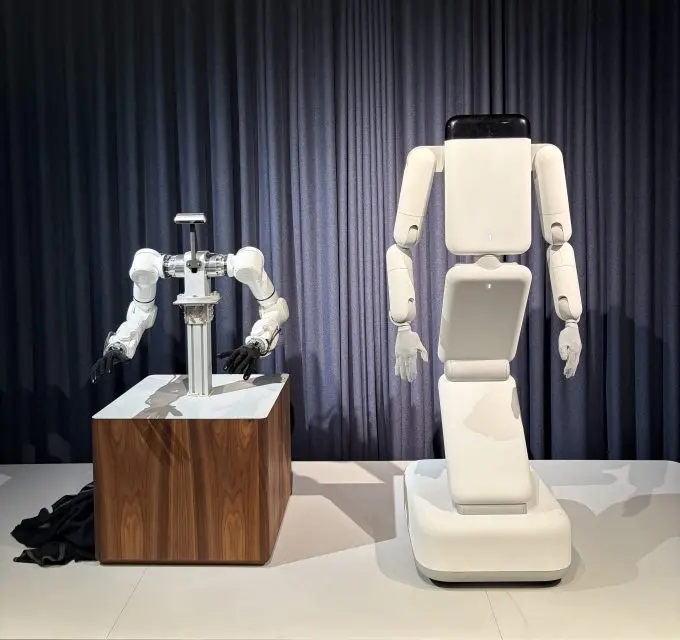
Genesis said it has built 30 to 40 Enos, but wasn’t ready to share how many it would make in the year ahead. The company would only say that a mass-manufacturing contractor had been chosen to start work next year in the U.S. and that the design of the mass-produced version had been finalized. The company is piloting the machine with a handful of undisclosed customers.
To realize the company’s vision, Xian says the key bottleneck is hardware capability, both in mechanical design and in the supply chains needed to produce industrial-grade machines. Right now, the company’s dexterous hands can only operate for a few weeks of regular work before they need to be replaced.
For truly generalized robotic intelligence, Genesis needs more data. Xian pooh-poohs the finer distinctions between architectures like Vision-Language-Action models and World-Action models. In his view, the software is ultimately transformers and attention, so “what really matters is is the whole infra — the training infrastructure, the data infrastructure, and the quality of the data.” He estimates that “the model architecture contributes to maybe 10% of of the final [result].”
“I don’t think we expect or we need another fundamental scientific leap,” he told TechCrunch. “No, we have all the recipes. It’s just about execution.”